
A Reflection on Liminal Spaces
Hyunah Cho 조현아 & Emily Langlois Hunt

This year’s journal brings together a range of contributions; a survey report, a community voices article, and two book reviews. The report presents findings from the 2022 survey of New Zealand Registered Music Therapists, offering valuable insights into the profession.
Music Therapy Provision in Aotearoa New Zealand: Findings of a 2022 Survey of Registered Music Therapists
Alison Talmage, Hyunah Cho & Helen Dowthwaite
Abstract: This article reports on a 2022 survey of New Zealand Registered Music Therapists, offering an overview of the current workforce. This builds on previous surveys in 2008 (remuneration) and 2016 (a broader picture of the current workforce). The purpose of these surveys was to inform Music Therapy New Zealand’s strategic planning and advocacy for the provision of music therapy in Aotearoa New Zealand and to inform other communities about work undertaken here.The 2022 survey achieved a response rate of 63%.
Memories and Melodies: Using a Portable Recording Station to Create a Christmas Album with Older Adults at Aged Care Facilities in Auckland
Sam Scott & Luke Stothart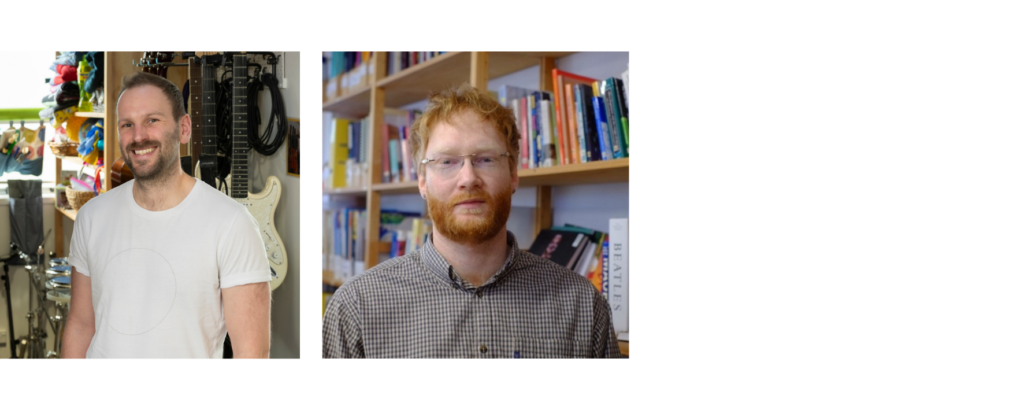
Abstract
This article presents a practice-based exploration of how two music therapists used sound recording equipment as a therapeutic tool in music therapy sessions across two aged care facilities in Auckland. Over a 10-week period from 4th October to 6th December 2024, sound recording equipment was integrated into music therapy sessions at the facilities with clients recording vocals alongside a range of instruments including guitar, ukulele and percussion. The therapists aim to share their recording process and, by drawing on their reflective practice, offer insights into the psychological benefits observed for clients.
Music Therapy with Autistic Children in Aotearoa, New Zealand / Haumanuā-Puoro mā ngā Tamariki Takiwātanga i Aotearoa (2022)
By Daphne Rickson
Reviewer: Rachael Hannah
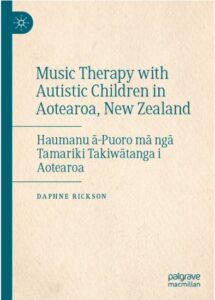

Music Therapy with Autistic Children in Aotearoa, New Zealand / Haumanu ā-Puoro mā ngā Tamariki Takiwātanga i Aotearoa summarises a research project in which commentators reflect on ten individual music therapy case studies. The impetus for this research began several years earlier, in response to barriers to accessing music therapy due to perceived lack of evidence.
The Handbook of Music Therapy: Second Edition (2024)
Edited by Leslie Bunt, Sarah Hoskyns & Sangeeta Swamy
Reviewer: Carmen Cheong-Clinch
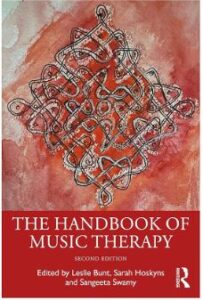
It has been more than 20 years since I read the first edition of The Handbook of Music Therapy in the months leading up to my decision to study music therapy at the University of Queensland in Brisbane, Australia. In 2000, I completed a Research Master of Education which investigated the relationship between music literacy and textual literacy (Cheong-Clinch, 1999), a study borne out of genuine curiosity – spurred by anecdotal stories from elated parents whose primary aged children’s literacy skills had seemingly improved after attending a year of music lessons with me.